How Much Does a New Roof Cost in Des Moines?
We get this one more than any other question — and you deserve a real answer, not a dodge.
Most residential roof replacements in the Des Moines metro right now run between $8,000 and $18,000+ for asphalt shingles with a full tear-off. That’s a wide range, and it’s wide for an honest reason: a simple ranch with a walkable pitch is a completely different job than a two-story with steep slopes, dormers, and three layers of old shingles underneath.
Here’s what actually moves your number:
Roof size and pitch — bigger and steeper costs more. Simple math, no way around it.
Material choice — standard architectural shingles like Owens Corning Duration are the most popular in Central Iowa and hit the sweet spot between price and performance. Class 4 impact-resistant shingles cost roughly 30–50% more on materials — but they can save you up to 20% a year on your insurance premium. For a lot of Iowa homeowners, that upgrade pays for itself in 3–5 years. We’ll show you the exact math for your carrier at your inspection.
What’s hiding underneath — rotted decking, old underlayment that’s turned to dust, previous repairs done wrong. Nobody can quote this accurately from the ground. We don’t guess at it, and you shouldn’t trust a contractor who does.
Here’s what we can promise: our inspection is free, includes a drone flyover with high-resolution photos, and we’ll give you a written, itemized estimate — not a ballpark. We’ve done this on 14,500+ Central Iowa properties. We know what things cost here, and we’ll give it to you straight.
$8K–$18K+
Typical Des Moines roof replacement range
Up to 20%
Insurance discount with Class 3/4 shingles
14,500+
Properties inspected across Central Iowa
1 of 8
OC Platinum Preferred in all of Iowa
★★★★★
“They found the culprits right away. They didn’t try to upsell me on anything before they did the repairs or other tactics I’ve seen. After they finished up we talked through a plan on how to fix the other issues I have going on and gave me an honest opinion on when we should want and/or expect to replace the roof.”
— Dan C.
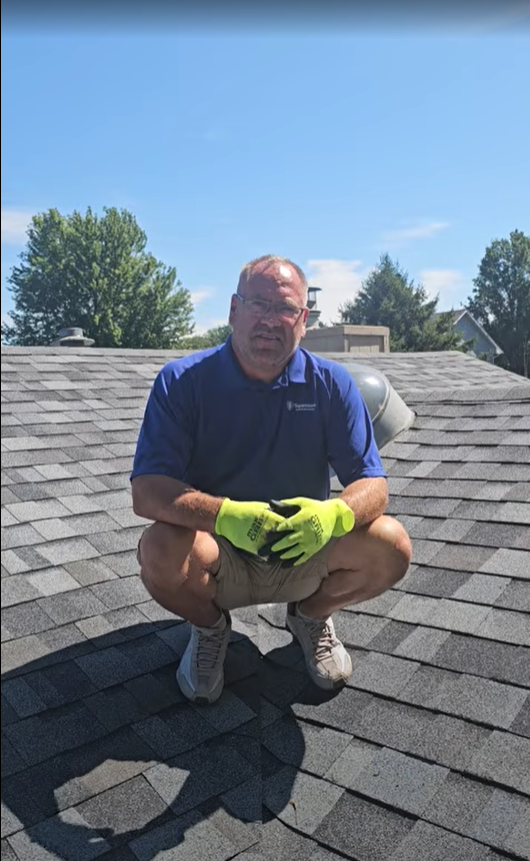
How Long Does a Roof Last in Iowa?
Shorter than the brochure says. That’s the honest answer.
Manufacturer warranties and marketing materials are based on ideal conditions. Iowa doesn’t do “ideal conditions.” We do hail, wind, ice dams, 95-degree summers, and -15-degree Januarys — sometimes in the same week in March.
Here’s what we actually see in the field, after inspecting thousands of Iowa roofs:
3-tab shingles: 15–20 years in Central Iowa. Nationally they’re quoted at 25, but Iowa weather doesn’t care about national averages.
Architectural shingles: 20–28 years. These are the most common shingle in the Des Moines metro — Owens Corning Duration is the standard. Good product, holds up well, but hail and UV still take their toll.
Impact-resistant shingles (Class 3/4): 25–35 years. Engineered to absorb hail impact without cracking. They genuinely last longer in our climate.
Metal roofing: 40–70 years. The most durable option we install. Essentially eliminates your hail worry.
The thing most homeowners don’t realize: a roof can look fine and still be compromised. Hail bruises shingles beneath the surface. Wind breaks seal strips you can’t see from the ground. We’ve pulled shingles off 12-year-old roofs that were shot, and we’ve seen 25-year-old roofs still going strong. The difference is usually installation quality, ventilation, and how much storm damage went undetected.
If your roof is over 15 years old in Central Iowa, it’s worth a look. Our inspections are free, and if your roof is fine, we’ll tell you that too. We wrote a deep dive on this: How Long Does a Roof Last in Iowa?
Your Roof Has a Story. We’ll Read It For Free.
How Do I Know If My Roof Needs to Be Replaced?
Sometimes it’s obvious — shingles in the yard after a storm, water stains on the ceiling. But more often in Iowa, the damage is invisible from the ground. That’s what makes our climate tricky.
The things you might notice: Curling or buckling shingles. Granules piling up in your gutters (those little pebbles are your shingle’s sunscreen — when they’re gone, the shingle is dying). Dark streaks. Moss. Sagging along the ridgeline. Any of those are worth a call.
The things you probably won’t notice: Hail bruises beneath the granule surface. Cracked shingle mats that haven’t started leaking yet. Broken seal strips from wind you slept through. Dented soft metals — vents, pipe jacks — that are slowly letting water in.
In 29 years of Iowa roofing, here’s what I’ve learned: the homeowners who catch damage early almost always spend less than the ones who wait until the leak shows up on the ceiling. By that point, you’re not just replacing a roof — you’re replacing plywood, dealing with mold, and facing a bigger bill.
We fly a drone on every inspection. You get photos of every plane of your roof, a written report, and an honest conversation about whether you need replacement, a repair, or nothing at all. Free, no obligation.
★★★★★
“Great group of experts! Excellent problem solvers and craftsmen who treated my home as if it were their own.”
— Cheryl S.
How Do I Know If My Roof Has Hail Damage?
Here’s the hard truth: you probably don’t. Not from the ground.
Hail damage on asphalt shingles isn’t always dramatic. It’s not always a hole or a missing shingle. Most of the time it looks like dark spots where granules got knocked off, soft spots where the fiberglass mat cracked beneath the surface, or subtle dimpling you’d never see unless you were standing on the roof. And if you’re not trained to spot it, you can be standing right on top of it and miss it.
What you can see from the ground: Check your gutters, downspouts, and siding for dents. Look at your air conditioning unit — if it’s dinged up, your roof took the same hit. Check window screens and the paint on your windowsills. These are ground-level clues that your roof needs a professional look.
What you can’t see: The soft metals on your roof — vents, pipe jacks, flashing — dent and crack before shingles do. Those damaged components can leak for months before you notice water inside. By then the decking underneath may already be compromised.
Don’t climb on your roof. It’s dangerous, and you can make damage worse. Let us fly a drone, document everything, and give you a condition report you can actually use — whether that means filing with your insurance company, planning a repair, or just keeping the report on file for your records.
We provide the detailed documentation and evaluation data homeowners need when working directly with their insurance company, though we are not public adjusters.
★★★★★
“Great experience with Chandler, checked out the roof after a storm. Definitely would recommend to anyone.”
— Jimmy L.
Had a Storm Recently? We’ll Check Your Roof for Free.
What’s the Difference Between Replacement Cost and Actual Cash Value on My Roof?
This one keeps Iowa homeowners up at night — and honestly, it should. The difference between these two coverage types can be $10,000 or more on the same roof claim.
Replacement Cost Value (RCV) means your insurance pays to replace your damaged roof at today’s prices, minus your deductible. Your 15-year-old roof gets replaced with a new one, and your carrier covers the cost. That’s the coverage most homeowners think they have.
Actual Cash Value (ACV) means your insurance pays the depreciated value of your roof — what it’s “worth” based on age and wear. So that same 15-year-old roof? Your carrier deducts a chunk for every year of age. On a $15,000 replacement, you could get a check for $5,000 and be responsible for the other $10,000 yourself. Plus your deductible.
Here’s the part that catches people off guard: Many Iowa carriers quietly switch your roof coverage from RCV to ACV when your roof hits 10 to 15 years old. Some do it at 20 years. It happens through an endorsement or rider on your policy — and most homeowners don’t know about it until they file a claim and the check comes back short.
We can’t tell you what your policy says — that’s between you and your agent. But we can tell you this: call your agent and ask. One phone call now could save you from a very expensive surprise later. And if you’re not sure what condition your roof is actually in, that’s where we come in. Our free inspection gives you the documentation to have an informed conversation with your carrier.
We provide the detailed documentation and evaluation data homeowners need when working directly with their insurance company, though we are not public adjusters.
What Is the Cosmetic Damage Exclusion — and Should I Be Worried About It?
Yes. You should at least be aware of it.
A cosmetic damage exclusion is a clause some insurance companies are adding to Iowa homeowner policies that says: if storm damage affects only the appearance of your roof — but it’s not actively leaking — they don’t have to pay for it.
Think about what that means in a hail state like Iowa. A storm rolls through, dents your shingles, knocks off granules, damages your vents — but nothing leaks right now. Your carrier’s adjuster can look at all of that and say: “That’s cosmetic. Not covered.”
Here’s what they’re not telling you: that “cosmetic” damage just shortened the life of your roof by years. Those bare spots without granules? UV is now eating the asphalt mat. Those dented vents? They’ll leak eventually. But under a cosmetic exclusion, you’re on your own.
This is one of the most significant shifts in the insurance industry right now, and a lot of Iowa homeowners don’t know it’s in their policy until they need it.
What to do: Pull out your policy and look for the words “cosmetic damage exclusion,” “marring exclusion,” or “appearance damage.” Then call your agent and ask point-blank: “Does my policy cover cosmetic hail damage?” If the answer is no, ask what it would take to remove that exclusion — or start shopping for a carrier that doesn’t include it.
We provide the detailed documentation and evaluation data homeowners need when working directly with their insurance company, though we are not public adjusters.
Don’t Wait Until the Check Comes Back Short.
What Should I Ask My Insurance Agent About My Roof — Before the Next Storm?
Most homeowners don’t look at their roof coverage until after the damage is done. By then, the policy terms are locked in. A 15-minute phone call with your agent now is the smartest financial move you can make as a Central Iowa homeowner. Here’s exactly what to ask:
1. “Is my roof covered at Replacement Cost or Actual Cash Value?” — If it’s ACV, find out why and what it would cost to buy back RCV coverage.
2. “Does my policy include a cosmetic damage exclusion?” — If yes, ask what’s specifically excluded and whether you can remove it.
3. “What’s my wind and hail deductible?” — Some policies have a separate, percentage-based deductible for wind/hail. On a $300,000 policy, a 2% deductible is $6,000 — very different from the $1,000 flat deductible you might be expecting.
4. “Do you offer a discount for impact-resistant shingles?” — Most Iowa carriers offer up to 20% off the wind/hail portion of your premium for qualifying Class 3 or Class 4 shingles. If you’re already paying for roof coverage, you might as well be saving on it.
5. “Can I choose my own contractor?” — Iowa law says yes. Get it in writing from your agent so there’s no confusion after a storm.
6. “Will my premium go up if I file a hail claim?” — In Iowa, hail and wind are generally classified as “acts of God.” Your individual rate shouldn’t increase for filing. But ask — and get the answer on the record.
If you want to go into that conversation armed with a current condition report on your roof — photos, measurements, documentation — that’s exactly what our free inspection provides. It puts you in a much stronger position to evaluate your coverage.
We provide the detailed documentation and evaluation data homeowners need when working directly with their insurance company, though we are not public adjusters.
What Are Class 3 and Class 4 Impact-Resistant Shingles — and Are They Worth the Money?
Short answer: in Central Iowa, almost always yes. Here’s why.
Impact-resistant shingles are rated using a test called UL 2218. Steel balls of different sizes get dropped onto the shingle from specific heights — basically simulating hail. If the shingle doesn’t crack, it passes.
Class 3: Survives a 1.75-inch steel ball dropped from 17 feet. Handles most Iowa hail events. Qualifies for insurance discounts.
Class 4: Survives a 2-inch steel ball dropped from 20 feet — two hits in the same spot — with no cracking. Highest rating available. Qualifies for the maximum discount, typically up to 20%.
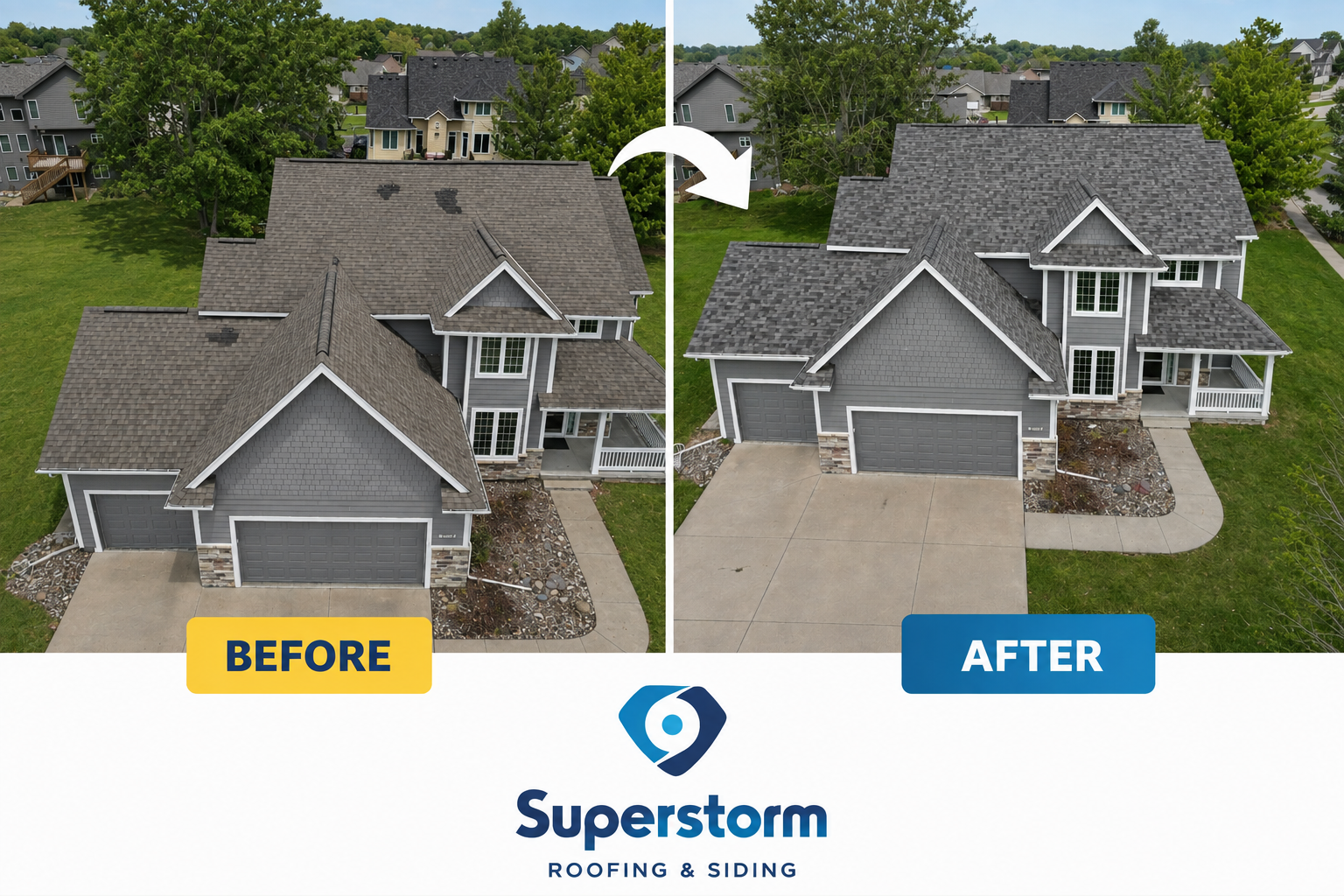
Now here’s where it gets interesting for Iowa homeowners. Polk County ranks in the top ten nationally for hail frequency. Standard shingles crack and fail in the storms we get here. Class 4 shingles — products like the Owens Corning Duration FLEX or the Malarkey Legacy — use polymer-modified or rubberized asphalt that flexes on impact instead of shattering. We’ve seen it firsthand on thousands of roofs: Class 4 homes come through storms that require full replacement on the standard-shingle house next door.
The upgrade typically costs 30–50% more on materials. But with the insurance discount, most homeowners recover that in 3–5 years. After that, you’re saving money every year. And at your free evaluation, we’ll pull up your specific carrier’s discount schedule so you’re making a real financial decision — not a guess.
Full breakdown: Impact-Resistant Shingles for Iowa Homeowners →
★★★★★
“Positive walk-through discussion… great attention to details. Reasonably priced. Did great work.”
— Travis E.
Ready to See If Your Roof Qualifies for a Discount?
Get Your Roof Answered — In 3 Quick Steps
Answer 3 quick questions. We’ll inspect your roof for free and tell you exactly where you stand — in writing, with drone photos.
What Kind of Warranty Do I Get With a Superstorm Roof?
The best one available. Anywhere. And that’s not marketing — it’s a fact you can verify.
As one of just 8 Owens Corning Platinum Preferred contractors in all of Iowa — top 1% nationally — we offer the Owens Corning Platinum Protection Limited Warranty:
50 years, non-prorated. Materials and labor are fully covered for manufacturer defects for the first 50 years. No depreciation, no reduced payouts, no fine-print phase-outs. Shingles, underlayment, starter strips, hip and ridge, ventilation — the whole system.
Lifetime workmanship coverage. If something goes wrong because of how the roof was installed, Owens Corning covers it. Even if we’re not around in 30 years (we will be — but even if), you’re still protected. That almost never happens with standard contractor warranties.
Transferable. When you sell your home, the warranty goes with it. That’s a real, documented selling point for buyers.
Here’s the thing most homeowners don’t realize: not every Owens Corning contractor can offer this warranty. It’s exclusive to the Platinum Preferred tier — and there are only 8 of us in the entire state. When you’re comparing roofing quotes, always ask: “What warranty tier can you actually provide?” The answer matters more than most people think.
★★★★★
“This company is so great. They go above and beyond. They put a new roof on my house 3 years ago and when I called them about a concern, they came right back out. That says everything about who they are.”
— Valarie H.
What Is the Good Contractors List — and What’s This $25,000 Guarantee?
This is one of our favorite things to explain, because most homeowners have never heard of it — and it’s genuinely one of the best consumer protections in the industry.
The Good Contractors List is a national organization that vets contractors the old-fashioned way: face-to-face interviews, business background checks, personal background checks, and ongoing monitoring. They’re not a lead-generation site that sells your phone number to four roofers. They’re the opposite — a screening service that exists to protect homeowners.
Superstorm was Iowa’s first roofing contractor to earn their $25,000 per-job workmanship guarantee. That means if anything goes wrong with the quality of our work, the Good Contractors List steps in as a neutral third party. They inspect the job, mediate the issue, and if we don’t make it right, they pay up to $25,000 out of their own pocket to get it fixed.
We didn’t write this guarantee. We can’t control it. It’s independent — and it exists because we earned it. Registration is free for homeowners. That’s a level of accountability most contractors won’t volunteer for.
Protected by a $25,000 Guarantee + a 50-Year Warranty.
How Do I Avoid Getting Scammed After a Storm?
We’ve been doing this in Iowa since 2012. After every major hail event, we watch the same thing happen: out-of-state trucks flood the Des Moines metro within 48 hours. Door knocks. High-pressure pitches. “We can start tomorrow.” “We’ll take care of your deductible.” They do the job — sometimes well, usually not — and they’re gone before you ever need the warranty.
Here’s how to protect yourself:
If they offer to pay or waive your deductible — walk away. That’s illegal in Iowa under §714.16. Period. Any contractor who offers it is either breaking the law or inflating the scope to hide the cost. Either way, you don’t want them on your roof.
Ask for their Iowa contractor registration number. It’s required by law. If they can’t produce it on the spot, they shouldn’t be knocking on your door.
Ask for certificates of insurance — both general liability and workers’ comp. If they don’t carry workers’ comp and someone gets hurt on your property, guess who’s exposed?
Check their Google reviews. Not just the rating — look at the dates, look at the locations, and look at how long they’ve actually been working in Central Iowa.
Ask what warranty they can actually offer — manufacturer tier, not just their own piece of paper. Get it in writing before you sign anything.
Our owner, Chandler Steffy, has been in construction since 1997 — 29 years. We have offices in Waukee and Clarion. Iowa contractor registration IAREG#C119347. We’re your neighbors, and we’ll be here long after the storm chasers leave.
★★★★★
“Highly recommend Superstorm! We couldn’t find anyone to take on such a small job, but they were up to the task!”
— Debbie A.
How Long Does It Take to Replace a Roof?
For most single-family homes in the Des Moines metro: 1 to 3 days from tear-off to final cleanup. A straightforward ranch with a walkable pitch can often be done in a single day. Larger homes, steeper roofs, or projects that need decking replacement take a bit longer.
The part that takes more time is the process around the installation — especially if you’re working with your insurance company. Between the inspection, the estimate, material ordering, scheduling, and weather windows, the full timeline from first call to completed roof typically runs a few weeks. After a major storm event, demand across Central Iowa surges and timelines stretch. That’s one more reason to get your inspection early — the homeowners who call first get scheduled first.
During the project, you don’t need to be home. We ask that vehicles are out of the driveway and pets are inside. You’ll have a dedicated project manager — one person, one phone number — from start to finish.
Where Does All the Debris Go? And What About the Nails?
The nails question — that’s always the spouse’s question. We love it. And we take it seriously.
Debris: We use pull-behind dump trailers, not dumpsters. The trailer arrives with the crew and leaves with the crew. No giant metal box sitting in your driveway for a week, no eyesore for the neighbors, no scheduling a separate pickup.
Nails: After every tear-off, our crews sweep the entire property with a rolling magnetic sweeper — driveway, yard, walkways, landscaping beds, everywhere. We do a final walk-around before we leave. And here’s our honest commitment: no process catches 100% of nails on the first pass. If one turns up in your tire two weeks later, call us. We’ll come back and sweep again. It’s not acceptable, and we don’t pretend it can’t happen.
Landscaping: Tarps go down around the perimeter before tear-off to catch falling debris. At the end of the job, we do a full property walk-through. Your yard should look the way it did before we got there.
No Dumpsters. No Nails Left Behind. No Excuses.
Can You Replace a Roof in the Winter in Iowa?
Yes — and sometimes you should.
Cold-weather installation requires different techniques: shingles stored in a temperature-controlled environment, hand-sealing where thermal activation can’t happen naturally, and careful handling to prevent cracking. Our crews are trained for it, and we don’t cut corners when the temperature drops.
Here’s something most homeowners don’t consider: if your roof has active damage heading into winter, waiting until spring means 3–4 more months of Iowa freeze-thaw cycles, ice, and snow working on compromised shingles. A small problem in November can become a much bigger — and more expensive — problem by April.
Winter also has advantages: scheduling is more flexible, material availability is better, and you’re not competing with every other homeowner in the metro who waited for the same warm-weather window.
We’ll tell you honestly whether a winter install makes sense for your situation. Sometimes it does, sometimes it doesn’t — and we’re not going to push it if the conditions aren’t right.
★★★★★
“I woke up after a rain storm to water coming out of my ceiling fan. It’s a holiday weekend, and Chandler came right out. That’s the kind of company you want on your side.”
— Sarah S.
How Do I Prevent Ice Dams?
If you’ve ever had an ice dam, you know — it’s not just an icicle problem. It’s a “water is getting inside my house and I don’t know how to stop it” problem. And in Iowa, it’s one of the most common winter roof issues we see.
Here’s what actually happens: heat escapes from your living space into the attic. That warm attic melts snow on the upper part of your roof. The meltwater runs down to the eaves — which are cold because they extend past the heated space — and refreezes. That ice dam backs water up under your shingles, past the drip edge, and into your home. Interior damage, mold, rotted decking — the works.
The fix isn’t a bigger gutter or more heat cable. It’s three things working together:
1. Attic insulation — keeps your heat downstairs where it belongs, not leaking into the attic and melting snow unevenly.
2. Balanced ventilation — continuous soffit intake and ridge exhaust keeps the roof deck uniformly cold so snow melts evenly (or not at all).
3. Ice and water shield — a self-sealing membrane installed along eaves, valleys, and transitions during roof installation. Your last line of defense if ice does form.
We check ventilation and insulation on every inspection. If your home has a history of ice dams, the root cause is almost always a ventilation or insulation problem — and we’ll tell you exactly what needs to be fixed.
Ice Dams? Hail Damage? Leaks? Let’s Find Out for Free.
Do I Need a Permit to Replace My Roof?
In Des Moines — yes. And in most surrounding cities in the metro. The City of Des Moines adopted the 2024 IRC standards effective January 2026, and all roof replacements require a building permit and inspection.
The good news: you don’t need to deal with any of that. We pull the permit, schedule the inspection, and make sure everything meets code. It’s built into our process.
Here’s why this matters beyond just following the rules: a roof replaced without a permit has no official record. That can cause problems when you sell your home, when you file a future insurance claim, or if a question ever comes up about whether the work was done to code. Storm chasers skip permits all the time — it’s one more reason to hire a licensed, local contractor who’s going to be here tomorrow.
What Roofing Materials Do You Install?
We install shingle systems from three of the industry’s top manufacturers: Owens Corning, Tamko, and Malarkey — in standard architectural and impact-resistant configurations. We also install the complete roofing system underneath: underlayment, ice and water shield, starter strips, hip and ridge, ventilation, flashing, and drip edge. The system under the shingles matters just as much as the shingles themselves.
As an Owens Corning Platinum Preferred contractor, we have access to OC’s full product line — Duration, Duration FLEX, Duration STORM, Berkshire. But we’re not an “Owens Corning only” shop. We carry Tamko Titan XT and Malarkey Legacy because they’re excellent Class 4 products that give our customers real options at different price points. We recommend the right product for your home, your budget, and your insurance goals — not the one with the highest margin.
Do You Offer Financing?
Yes. We offer financing through FNBO (First National Bank of Omaha) for homeowners who want to spread the cost into monthly payments. This is especially helpful when insurance doesn’t cover the full replacement, or when you’re choosing to upgrade to impact-resistant shingles out of pocket to lock in the long-term insurance savings.
Rates and terms are set by FNBO based on your application — we don’t mark anything up. We’ll walk you through the options at your evaluation so you can make the decision that fits your budget.
Financing Available. Warranty Included. Zero Pressure.
Are You Licensed and Insured?
Yes — and you should ask every contractor this question. If they hesitate, that tells you everything.
We carry general liability insurance and workers’ compensation coverage, and we’ll hand you the certificates without being asked twice. We’re a licensed Iowa contractor — registration IAREG#C119347. Owens Corning Platinum Preferred, top 1% nationally, 1 of 8 in Iowa. BBB accredited. Vetted member of the Good Contractors List with a $25,000 per-job guarantee.
We’re not going anywhere, and we have nothing to hide. That’s the baseline for any contractor who deserves to be on your roof.
How Do I Get Started?
Pick up the phone or fill out the form. That’s it.
(515) 225-4880 — we answer 24/7, real people, no phone tree. Or request your free inspection online and we’ll call you.
A project manager will schedule your drone inspection — usually within a day or two — and then sit down with you, go through every photo, and give you an honest assessment of where your roof stands. If it needs work, we’ll tell you exactly what and why. If it doesn’t, we’ll tell you that too. Written report, no obligation, no pressure.
We serve Des Moines, Ankeny, Urbandale, West Des Moines, Waukee, Clive, Altoona, Ames, Fort Dodge, Johnston, Grimes, Norwalk, Clarion, and all of Central Iowa. We’ve been here for 29 years. We’ll be here for the next 29.
Still Have a Question? We’d Rather Talk Than Type.
Free drone inspection. Honest answers. No sales pitch.
Serving Des Moines and all of Central Iowa since 2012.
📞 Call (515) 225-4880
Book My FREE Inspection
⭐ 4.9/5.0 — Hundreds of 5-Star Reviews | Iowa Licensed IAREG#C119347 | Calls Answered 24/7