How Long Does a Roof Last in Iowa? Warning Signs You Need a New Roof
If you’re a homeowner in Iowa, your roof takes a beating—hail, wind, heat, humidity, and freeze-thaw cycles can all shorten a roof’s lifespan. So if you’ve started wondering “How long does a roof last?” you’re not alone.
Our team at Superstorm Roofing & Siding has inspected over 14,500 properties across Central Iowa since 1997, and we see firsthand how Iowa’s climate affects every type of roof. In this guide, we’ll break down how long roofs typically last in Iowa in 2026, what factors cause roofs to fail early, and the warning signs that it might be time for a replacement. If you’re already seeing damage from a recent storm, you may want to explore professional roof repair services in Iowa before minor issues turn into costly structural problems.
Quick Answer (Iowa 2026):
Most architectural shingle roofs in Iowa last around 20–30 years, but storm damage, poor ventilation, or installation issues can reduce that. If your roof is 15+ years old and you’re noticing missing shingles, granule loss, leaks, or frequent repairs, it may be time for an evaluation.
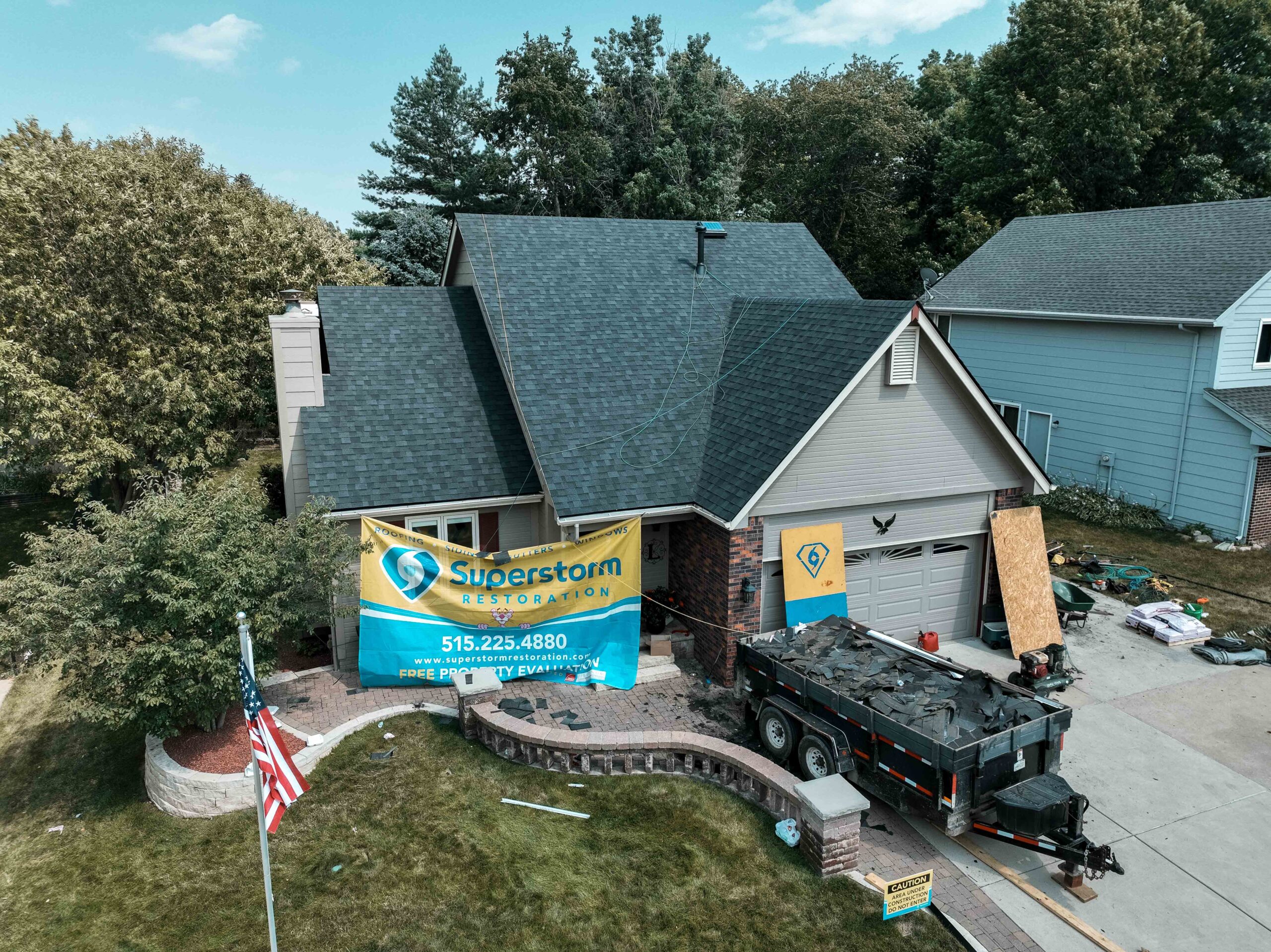
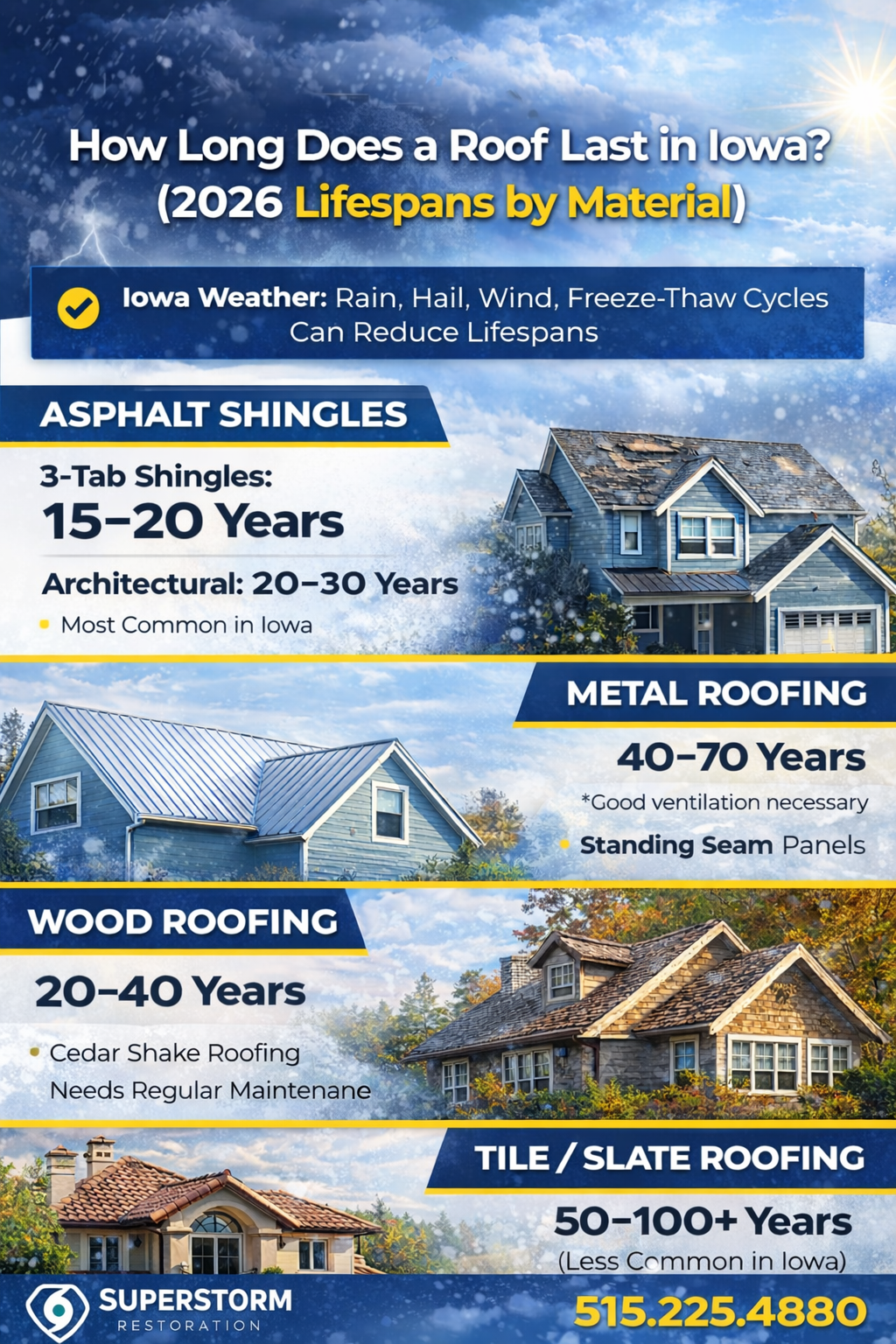
How Long Does a Roof Last in Iowa? (Average Lifespan by Material)
Here are realistic roof lifespan ranges for Iowa homeowners:
Asphalt Shingles (Most Common in Iowa)
- 3-tab shingles: 15–20+ years: Nationally, 3-tab shingles are often quoted at 15–20 or 15–25 years, but Iowa’s weather pushes real-world performance toward 15–20 years (or lower) more consistently than in sunnier or calmer areas.
- Architectural shingles: 20–30 years: in Des Moines, Iowa & Central Iowa (Midwest with cold winters, hot summers, potential hail/wind), expect closer to the 20–28 year range depending on the specific product, roof pitch/ventilation, and maintenance—regular inspections can help maximize it
- Impact-resistant shingles: 25–35 years: (varies by product and installation). The average U.S. roof replacement occurs around 17–20 years for asphalt systems, influenced by factors like weather exposure, hail, wind, and regional differences (e.g., shorter in severe weather areas like hail-prone Midwest states, longer in milder climates). Learn more about impact-resistant shingles and how they protect Iowa homes.
Metal Roofing
- Standing seam/metal panels: 40–70 years: Under new insurance policies, most metal roofs come with a “Cosmetic Clause,” which eliminates metal from being insured due to hail damage. A metal roof MUST have functional damage to be approved in an insurance claim. In other words, it must leak, and only the panels that are affected will be replaced.
Cedar Shake / Wood Roofing
- Cedar shake: 20–40 years: In Iowa’s climate—with extreme temperature swings, heavy snow/ice, frequent hail, high winds, humidity, and freeze-thaw cycles—cedar shake roofs typically last 20–30 years on average with proper maintenance.
Tile/Slate Roofing
- Tile/slate: 50–100+ years (less common in Iowa homes)
Commercial & Flat Roofs
Iowa commercial property owners face the same weather extremes. Here are typical flat roof lifespans in Central Iowa:
- EPDM (rubber membrane): 25–30 years — affordable and easy to maintain, but seams can fail under Iowa’s freeze-thaw cycling
- TPO: 15–20 years — stronger seam welds than EPDM and energy-efficient, but less flexible in extreme cold
- PVC: 20+ years — UV-resistant and energy-efficient, but a higher upfront investment
- Spray foam: 50+ years with regular recoating — excellent insulation value, but requires maintenance every 10–15 years to maintain the protective coating
Need a commercial roof evaluation? Learn about our commercial roofing services.
How Warranties Compare to Roof Lifespan in Iowa
A roof’s warranty and its actual lifespan are two different things. The warranty protects your investment if the roof fails prematurely — from a major storm, a manufacturing defect, or an installation error. Higher-quality materials come with longer warranties because they’re engineered to last.
As an Owens Corning Platinum Preferred contractor — one of only 8 in Iowa and the top 1% nationally — Superstorm Roofing & Siding offers one of the strongest warranty packages in the state:
- 50-year lifetime limited material warranty from Owens Corning (first 25 years at 100% coverage, next 25 years prorated)
- 25-year labor warranty backed by Owens Corning through the Platinum Preferred program
- 10-year workmanship guarantee directly from Superstorm Roofing & Siding
That combination means your roof, the labor, and the installation are all covered — something most contractors in Iowa simply cannot offer. It’s also backed by Iowa’s first $25,000 Good Contractors List guarantee.
Why Roofs Wear Out Faster in Iowa
Even a high-quality roof can age faster when it’s exposed to Iowa conditions year after year. Homeowners in Des Moines, Ankeny, West Des Moines, and across Central Iowa deal with a combination of weather extremes that most parts of the country simply don’t face.
1) Hail Damage (Even When It’s Not Obvious)
Hail doesn’t always create visible holes. It can bruise shingles, knock off granules, and weaken the protective layer. Learn more in our complete guide to hail damage and what it does to your roof.
- The protective layer is also known as the asphalt matting or membrane
- Hail can cause microfracture to the matting
- Hail damages soft metals such as roof vents, pipe jacks, and other metal components—leading to leaks months later
2) Wind Damage and Lifted Shingles
Iowa wind can lift shingles and break the seal strip. That allows water to push underneath during rainstorms.
- Wind also lifts the shingles pulling the nail through the asphalt matting of the shingle.
- Wind causes creasing of the shingles.
- Wind causes tearing of the shingle.
- Wind causes shingles & underlayment to be blown off the roof system exposing the roof deck system.
3) Freeze–Thaw Cycles
Iowa winters feature frequent temperature swings above and below freezing (sometimes multiple times per week), causing water in cracks, under shingles, or in materials to expand and contract. This leads to cracking, splitting, granule loss, and seal failures in shingles, plus loosening of fasteners and underlayment—often called the “silent roof killer” in the Midwest.
4) Poor Attic Ventilation
Improper ventilation can trap heat and moisture—Moisture and humidity issues — High humidity, heavy rains, and poor drainage trap moisture, promoting mold, algae, rot (especially on cedar shakes), and accelerated breakdown—exacerbated by inadequate attic ventilation that traps heat/moisture year-round. Learn more about how roof ventilation affects your roof’s lifespan.
5) Installation Quality
Even the best roofing materials will fail early if they’re not installed correctly. A roof is a complete system — shingles, underlayment, flashing, ventilation, and sealing all have to work together.
Common installation issues that shorten roof life in Iowa include improper nailing, poor flashing around chimneys and valleys, missing ice & water shield, and inadequate ventilation. Under Midwest wind, hail, and freeze–thaw cycles, small mistakes become major problems fast.
A roof that should last 25+ years can fail in 10–15 if craftsmanship is weak. That’s why choosing an Owens Corning Platinum Preferred contractor matters — it means verified craftsmanship and the strongest warranties available.
6) Overall seasonal extremes
The combination of all these (no “mild” off-season) creates cumulative wear—materials fatigue faster from constant expansion/contraction, impacts, and environmental attacks.
7) Intense summer heat and UV exposure
Hot, humid summers (90s°F+) dry out asphalt, making shingles brittle, cause curling/warping, and speed up granule loss—UV rays break down materials faster when combined with prior winter damage.
Even the best materials won’t last if:
- Product is not installed according to manufacturing specs.
- Product is not installed according to city and state codes
- Flashing is improperly installed
- Improper Valley installation. There are many ways to install valleys, as not all involve “cuts.”
- Not installing proper ice & water shield and underlayment requirements.
- Improper installation of hip & ridge shingles. A roof that “should last 25 years” can fail in 10–15 years if craftsmanship is weak.
How old is your roof? Don’t guess — find out for free.
Should You Repair or Replace Your Roof?
Here’s a simple Iowa homeowner rule of thumb:
Roof Repair Might Make Sense If: (Again, we must consider coverage in every example below)
Opt for repairs if the issues are minor and localized and your roof is relatively young (under 10–15 years old or still well within its expected lifespan with good remaining life). Repairs are cheaper upfront and can extend the usable life.
- Damage is isolated (e.g., a few missing shingles from wind, a small leak around flashing/vents, or limited hail impact on one slope).
- Roof age is under 15 years (for asphalt in Iowa) and there are no widespread signs of failure.
- No structural issues (no sagging, rot in decking, or recurring leaks).
- Professional inspection shows the underlayment, decking, and the majority of shingles are sound.
- You’re planning to sell soon or want to delay major spending.
Typical costs (2025–2026 national averages, similar in Iowa): $350–$1,900 for most jobs (e.g., $300–$800 for minor shingle fixes, $800–$2,500 for leaks/flashing). Larger patches might hit $2,500–$6,500, but still far less than full replacement.
Roof Replacement Is Usually Smarter If:
Replacement is usually recommended if damage is extensive, the roof is nearing/past its lifespan, or repairs would be frequent and costly. In Iowa, where weather is severe, patching an old roof often leads to recurring issues—replacement provides a fresh start with better materials (e.g., impact-resistant shingles for hail).
- Roof age is 15–20+ years (common threshold in Iowa for 3-tab/architectural asphalt; even if it “looks okay,” hidden deterioration from cycles is likely).
- Widespread damage: Curling/cracked/buckled shingles across multiple areas, heavy granule loss, missing shingles on several slopes, or damage affecting more than 30–50% of the roof.
- Recurring or multiple leaks, interior water stains/mold, or ice dam problems that keep returning.
- Sagging roof deck, soft spots, daylight in the attic, or significant rot/mold from moisture intrusion.
- A recent major storm (hail/wind) caused broad issues—insurance may cover much of the replacement anyway.
- Frequent repairs in the past few years signal the roof is at the end of its life.
Typical costs (2025–2026 averages): $5,900–$12,900 nationally for a standard home (often $8,000–$25,000+ in Iowa depending on size, pitch, materials, and removal of old layers). Higher for premium options such as architectural shingles or metal (better suited to Midwest durability). Financing options are available for Iowa homeowners.
Quick Decision Guide for Des Moines Homes
- Repair if: Roof <15 years old + isolated issues + no major red flags.
- Replace if: Roof 15–20+ years old OR extensive/widespread damage OR structural concerns OR you’re seeing 3+ warning signs (curling, granule loss, leaks, sagging, etc.).
- Gray area (get inspection): 12–18 years old with moderate damage—repairs might buy 3–5 years, but replacement could save money long-term by avoiding escalating fixes.
Bottom line: Always start with a professional inspection (many Iowa roofers offer free inspections, especially after a storm or for insurance claims). They can assess hidden damage (e.g., decking rot from ice dams) that homeowners miss. In your climate, erring toward the replacement of older roofs often prevents emergencies like interior flooding during winter melts or summer storms.
Wondering if it’s time to repair or replace? We’ll tell you — free, no pressure.
How to Tell If You Have Hail or Wind Damage
Telling hail from wind damage isn’t always obvious from the street—both can mess with your roof without screaming “obvious.” Here’s how to spot each one, step by step. Keep in mind, we are not up there with you, so grab binoculars or a ladder if safe, or call a roofer—they use drones or infrared to catch hidden stuff Iowa storms leave behind.
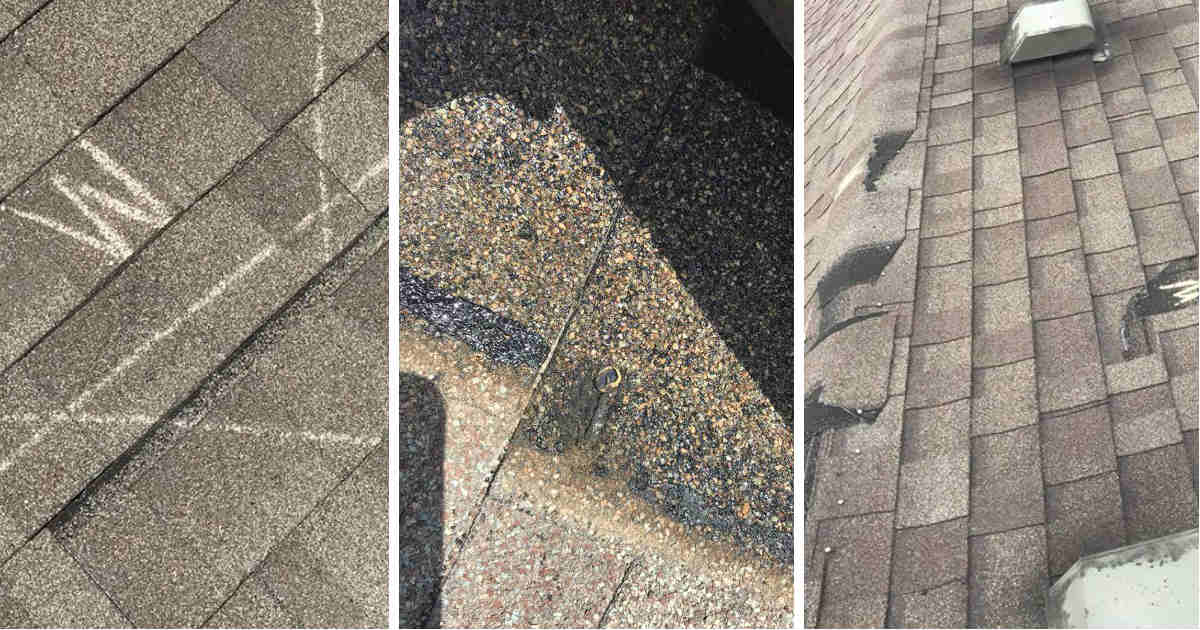
For hail damage: Look for round dents, bruises, or cracks on shingles—hail hits like golf balls, leaving “dimpled” spots or chipped edges. Granules (those rock-like bits) might be missing in clusters, like bald patches, since hail knocks ’em off. Check gutters for piles of those granules after a storm. If it’s asphalt, shingles could look bruised or have small holes; on metal or cedar, expect actual punctures or splits. In Des Moines, even pea-sized hail from last summer’s storms can build up over time—feel for soft spots on the roof if you can safely poke around.
Wind damage? That’s more about lifting or tearing—shingles might be flipped up, missing entirely, or have torn tabs, especially on the edges or ridges. Look for loose flashing around vents or chimneys that’s peeled back, letting water in. High winds (common here in spring) can crease shingles without breaking ’em, or strip them clean off in patches. If branches scraped it, you’d see linear scratches too.
Either way, combine signs: Hail bruises + wind lifts = total chaos. Snap photos for insurance and get an inspection—they’ll confirm before it leaks during the next melt.
How Long Does a Roof Last After a Hail Storm?
After a hailstorm, your roof’s life depends on how bad the hit was—no fixed number, since it varies by the size of hail, material, and Iowa’s ongoing weather beating it down. But here’s the deal: if hail was golf-ball sized or bigger, even “impact-rated” shingles might only buy you two to five years before leaks or cracks show up—granules gone, seals broken, water sneaking in. Smaller items, like pea-sized, could stretch it five to ten years if the roof was newish, but expect inspections yearly because freeze-thaw here accelerates everything.
Bottom line, don’t guess—have a roofer check for bruises or dents right away. Most folks in Des Moines replace sooner rather than later after big ones, insurance or not. Homeowners in Urbandale, Johnston, Waukee, and Grimes see the same storm systems — if your neighborhood got hit, your roof likely did too.
That’s why post-storm inspections are so important in Iowa.
Roof Replacement Timing: When Should You Replace It?
In Iowa, roof replacement timing depends on age, storm damage, and your insurance coverage—especially since many carriers are tightening coverage for older roofs, shifting toward Actual Cash Value (ACV) instead of full Replacement Cost Value (RCV). No statewide law forces a switch exactly at years 9-12, but industry trends and insurer practices are moving policies as early at 9 years to ACV policies. Contact your agent to confirm your coverage. Many roofs are flagged around 10 years for reduced coverage, leaving you on the hook for more after hail or wind.
- Under 10-12 years old—If your asphalt roof’s still fresh (say, 5-9 years), and damage is minor/localized (a few hail dents, wind-lifted tabs), repair it. Insurance typically pays the full RCV—full replacement cost minus the deductible—without depreciation. Storm season (spring hail/wind) is prime for claims; act fast post-event for best payout.
- Around 9-12 years (the “gray zone”)—This is where policies often flip. Many Midwest insurers (including some in Iowa) start depreciating heavily or switch to ACV at ~10 years—your payout drops to “current value” (e.g., 50-70% less for a 12-year roof). Hail, bruises, or wind tears? You might get partial cash, not enough for a full new roof—out-of-pocket jumps. If hail hit last year, don’t wait; inspect now—hidden cracks worsen with freeze-thaw, and claims get denied if you delay.
- 15+ years (common Iowa cutoff)—Replace it outright. Asphalt lasts 15-20 years here at most due to our extremes—hail dents, granule loss, and curling from ice dams. Repairs? Waste of money. Insurance on ACV means even big storm claims pay depreciated (you cover 60%+), plus high wind/hail deductibles (1-5% of home value—could be $2k-$10k). Better to replace pre-storm with impact-resistant shingles—locks in RCV if you shop policies.
Why Iowa Storms Push It Earlier
Hail (April-June peak, up to golf-ball size) and wind strip protection fast—granules gone means UV/heat breakdown speeds up. One big hit on a 10-year roof? Could shave 5+ years off life, turning “maybe repair” into “must replace” before next winter’s ice dams leak inside. Check the attic for rot post-storm; that’s your red flag.
Serving Iowa: Schedule a Free Roof Evaluation
Superstorm Roofing & Siding serves homeowners across Central Iowa with professional roofing, storm damage restoration, and exterior services. With over 14,500 properties inspected and a 4.9-star Google rating, we’ve earned our reputation as one of Iowa’s top-rated roofing contractors.
We proudly serve:
- Des Moines metro: Ankeny / Altoona / Norwalk / West Des Moines / Waukee / Clive / Urbandale / Windsor Heights / Grimes / Johnston / Polk City / Granger / Adel
- Central Iowa: Ames / Boone / Newton / Pella / Indianola / Winterset / Pleasant Hill / Dallas Center
- North Central Iowa: Fort Dodge / Webster City / Eagle Grove / Iowa Falls / Clarion
If you’re unsure whether your roof needs repairs or replacement, schedule a free property evaluation. We’ll inspect the roof, document what we find with drone footage, and walk you through the best next step—no pressure.
Your roof has an expiration date. Find out where yours stands — free.
Smart Play
Review your policy yearly—ask the agent, “RCV or ACV?” Any age trigger? If it’s shifting soon (common at 10), replace before a claim—avoids lowball payouts. Free inspections from local roofers (post-storm) spot hidden damage. In Des Moines, spring’s ideal for full jobs—dry, contractors are busy but available. Bottom line: If you’re hitting 10-12 and see wear, don’t gamble—a new roof now beats emergency fixes later.
FAQ | Frequently Asked Questions
How long does a roof last in Iowa?
Asphalt shingles: 15–20 years max here (shorter than the national 20–30 due to storms and cycles). Cedar shakes: 20–30 with care. Anything past 15? Start planning a replacement—hail/wind accelerates wear.
How do I know if my roof needs to be replaced?
Curling/cracked shingles, granule piles in gutters, missing tabs from wind, hail dents/bruises, leaks/stains inside, sagging deck, or ice dam marks. If 15+ years old and these show, don’t patch—replace.
Can hail damage shorten the lifespan of a roof?
Yes. Hail can bruise shingles and remove granules, weakening the roof system and reducing lifespan even if you don’t see immediate leaks.
How often should I have my roof inspected in Iowa?
Most homeowners should schedule a roof inspection once per year, and always after major hail or wind storms. Schedule your free inspection here.
What’s the best roof type for Iowa weather?
Impact-resistant architectural shingles (hail/wind-rated). Metal or synthetic for longevity. Avoid basic 3-tab—too fragile here. Steep pitch helps with snow/ice.
How long does a roof last after a major wind storm?
If wind lifts shingles or breaks seals, it can quickly reduce roof life—especially if water starts getting underneath the shingle layers.
Do I need a new roof if I have one leak?
Not always. A single leak may be repairable, but multiple leaks or widespread storm damage often points to a full replacement being the smarter long-term solution.
Does homeowners’ insurance cover roof replacement in Iowa?
Yes, under Coverage A (wind/hail are “covered perils”). But it depends: RCV pays full replacement cost (minus deductible); ACV pays depreciated value (you eat the rest—a big hit on older roofs). Many policies shift to ACV around 10 years old—check yours. Learn more about how we assist with insurance claims documentation.
When does insurance switch from RCV to ACV?
No strict Iowa law, but carriers often depreciate heavily or flip to ACV at 9–12 years (age-based, per policy). Hail claim on a 10-year roof? Expect partial payout—out-of-pocket jumps. Shop policies with RCV endorsements if possible.
Should I repair or replace after a storm?
Minor/local (few dents, lifted tabs)? Repair if under 10–12 years. Widespread hail bruising, wind tears, or 15+ age? Replace—repairs waste cash in our climate. Get a free post-storm inspection; insurance may cover the full cost if RCV.
How much does a roof replacement cost in Des Moines?
$8,000–$20,000+ average (size, pitch, and material). Insurance covers most storm jobs if claimed right—deductibles are 1–5% of home value, though. See our full breakdown: How Much Does a New Roof Cost in Iowa (2026). Financing is available.
What about ice dams or ventilation?
Big Iowa issue—poor attic vent lets heat melt snow, refreeze, and back up water. Fix with better insulation/vents during replacement—prevents rot/leaks. Read our full guide on how to prevent ice dams.
Should I wait for the insurance payout after a hail event?
No—inspect ASAP (hidden cracks worsen with thaw). Claims are denied if you delay. We provide the detailed documentation and evaluation data you need when working directly with your insurance company — learn more about our insurance claims process.
Bottom line: Iowa’s storms make roofs a ticking clock—age 15+ plus damage? Replace before the next hit. Schedule your free evaluation — we answer these questions every day for homeowners across all of our Iowa service areas.
Ready to find out how much life your roof has left?
Recent Posts
- Class 3 & Class 4 Shingles: The Real Value — and the Fine Print on Insurance Rebates
- What to Do After a Wind or Hail Storm in Iowa (Homeowner Checklist)
- How Much Does a New Roof Cost in Iowa (2026)?
- How Long Does a Roof Last in Iowa? Warning Signs You Need a New Roof
- Understanding Gutter Types and Sizes
- Giving Back To Our Community
- Prepare Your Home And Business For Severe Wind Storms Like A Derecho
- Comprehensive Guide to Roof Financing for Property Owners
- Understanding Your Insurance Claim After a Storm
- Protect Your Roof To Protect Your Home – Roof Maintenance Checklist for Every Season